Methodology
How Does It Work? The QNI in a Nutshell
Everyone has a nationality (citizenship) of one or more states. States’ characteristics differ greatly — the landmass of the Russian Federation is huge, while Eswatini’s is small; Luxembourg is rich, Mongolia less so. Just as states differ, so too do nationalities themselves. The key premise of the QNI is that it is possible to compare the relative worth of nationalities, not simply of countries. We believe that because a nationality is a legal status that significantly impacts its citizens’ lives both inside and outside the territory of the conferring state, knowing the comparative value of a nationality is hugely important.
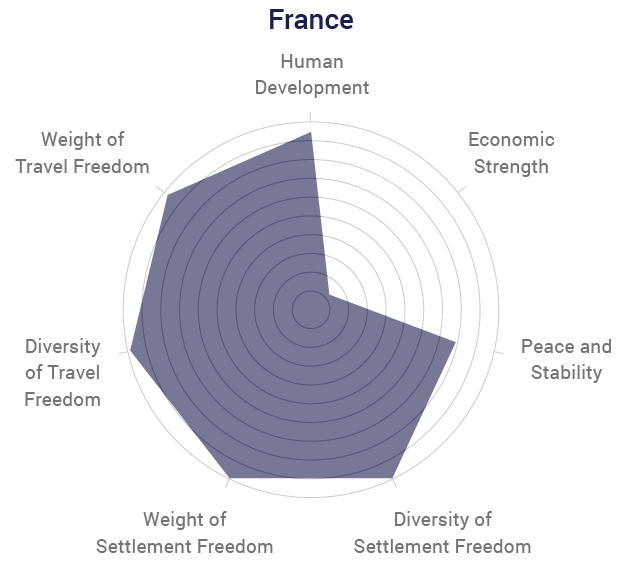
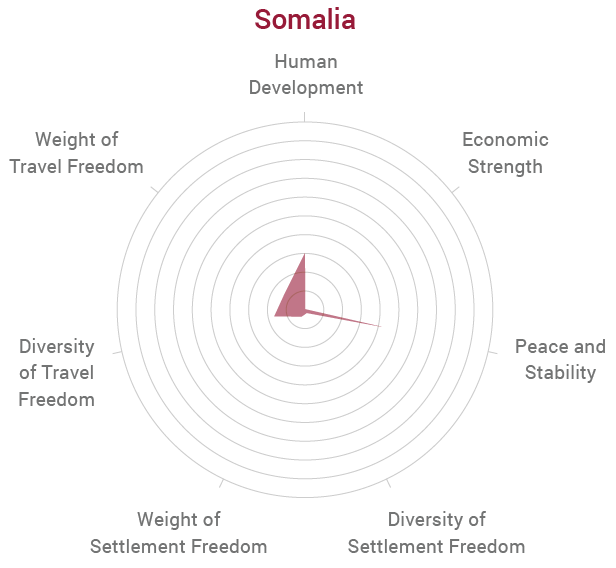
For a reliable comparison of nationalities, it is important to consider both internal and external factors.
Internally, the QNI looks at how successful the country is in terms of human development, economic prosperity, and stability and peace.
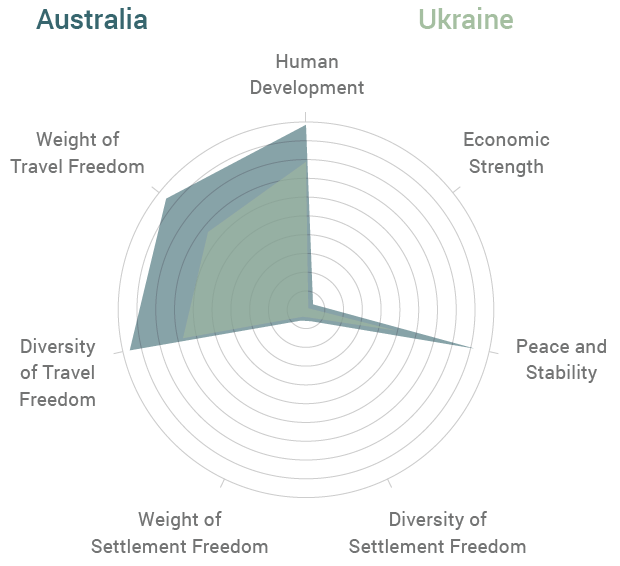
It is preferable to have the nationality of a country with long life expectancy, a good education system, and a high level of prosperity, such as Australia, than that of a country that offers less security and poorer education and health care to its nationals, such as Ukraine.
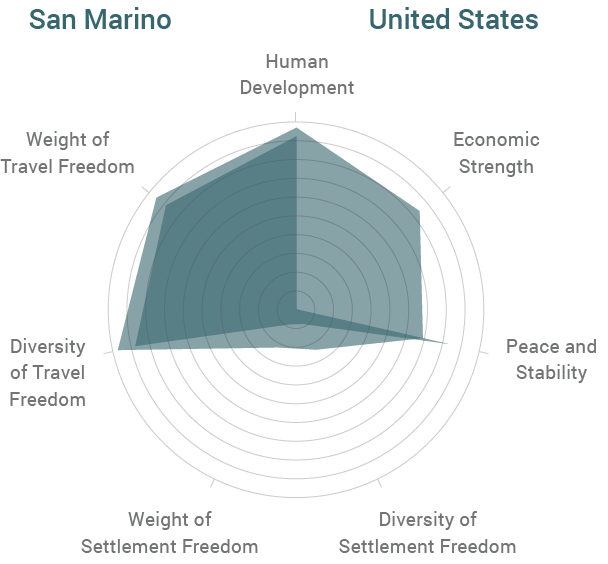
It is better to have the nationality of a country with a large economy, like the United States — and as a consequence, enjoy the rights to work and reside in it — than in a tiny country, however prosperous, like San Marino.
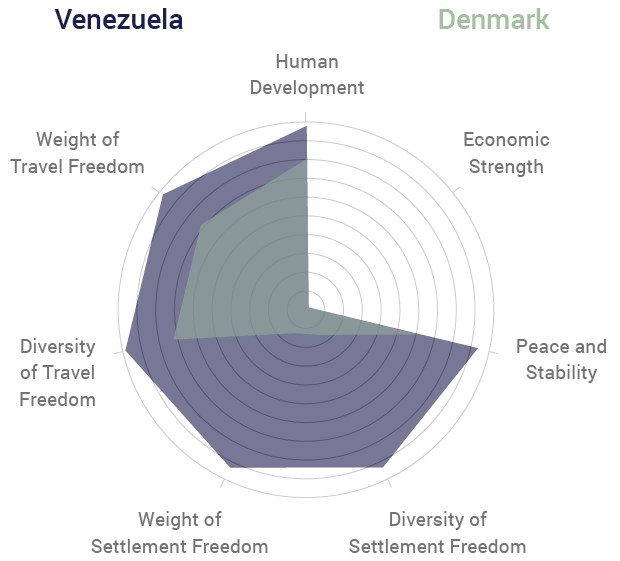
It is better to have the nationality of a peaceful and stable country, like Denmark, than that of a country with security risks, like Venezuela.
The QNI takes three internal factors into account:
- Economic Strength
- Human Development
- Peace and Stability
External factors are no less important, however: some nationalities allow their holders to travel all around the world unobstructed, with no questions asked.
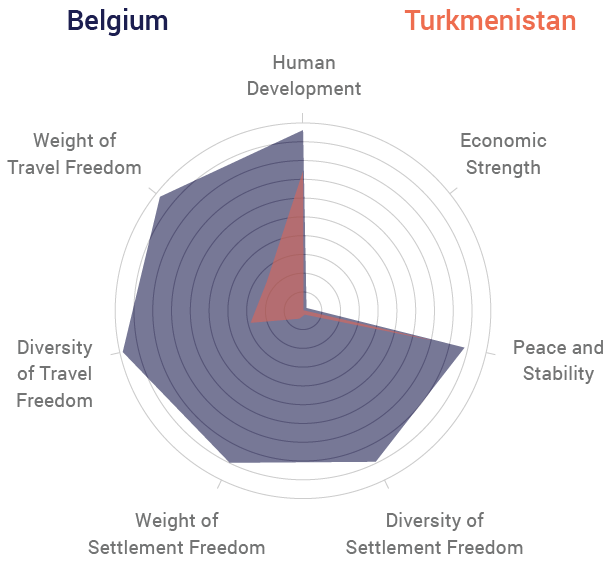
Consider the Belgian nationality, for instance, which allows visa-free or visa-on-arrival access to 176 countries and territories. Other nationalities require the acquisition of endless visas for tourist and business travel, and at times make such travel de facto impossible. The Turkmen nationality, for example, enables visa-free or visa-on-arrival access to only 51 countries and territories.
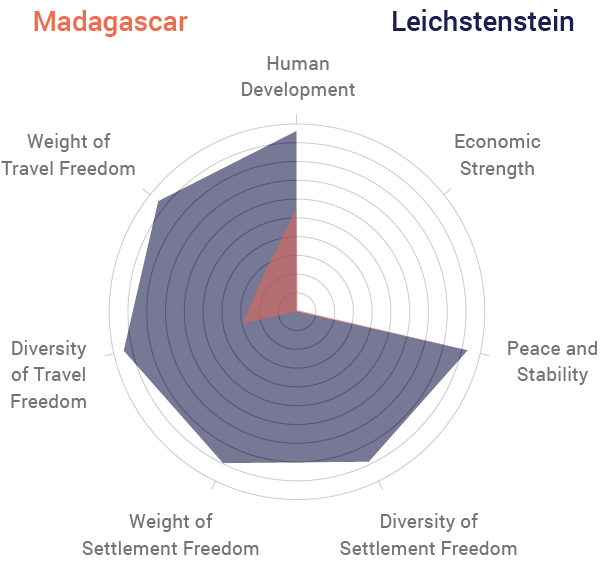
More importantly, however, most of the world’s nationalities confer a right on their holders to be welcomed by other countries and societies besides their own — a right to home treatment. In this sense, possessing one nationality can give rise to plentiful rights in a number of states as opposed to in just one, including the right to work and the right to settle. Liechtenstein nationality, although conferred by a tiny country, gives its bearers full access to all the EU Member States and all the countries of the European Economic Area: Liechtensteiners are at home in 41 countries and territories, enjoying all the rights that the bearers of the local nationalities enjoy. When one compares this with Madagascan nationality, for example, which is associated with no such extraterritorial rights at all, the difference becomes clear.
Two external elements used to evaluate any nationality’s worth are therefore extremely important:
- Travel Freedom
- Settlement Freedom
To reflect the added value of both elements in the most effective way, the QNI looks at two criteria. The first criterion is the number of other jurisdictions one can travel to or settle in while holding a particular nationality, because the diversity of the places one can live in or visit based on one’s nationality has a profound effect on quality of life. In this respect, Liechtensteiner nationality is better than Madagascan nationality, and German is better than Turkmen.
The second criterion takes into account the Human Development level and Economic Strength of every possible country that a person with a particular nationality can travel to or settle in. By this measure, being able to travel to France visa-free is of greater added value than being able to visit war-torn Syria visa-free. The same is true for settlement: having an unconditional right to work and live in Germany, for instance, puts Icelandic nationality above Chinese nationality, since Chinese nationality does not even allow settlement and work in the totality of the territory of the issuing state itself. Indeed, the Special Administrative Regions of Macao and Hong Kong require mainland Chinese nationals to acquire permits to settle in or even visit them.
All of these factors were taken into consideration to create the QNI: Kälin and Kochenov’s Index allows for an objective and impartial comparative assessment of the worth of all the world’s nationalities. By taking both internal and, crucially, external factors into consideration, the QNI offers a clear account of which nationalities are objectively better than others, and disproves a number of unhelpful mythologies — such as that the possession of any nationality is equally fine or that the most prosperous and economically important countries provide their nationals with the best nationality.
Intuitively, we have suspected all along that some nationalities were great while others were, quite simply, terrible; now we know which are which, and the Index’s intuitively understandable round charts allow for easy comparisons. The QNI divides the nationalities of the world into five tiers based on quality: Very High Quality, High Quality, Medium Quality, Low Quality; and Very Low Quality. This division gives a very clear idea of the standing of each of the world’s nationalities at a glance.
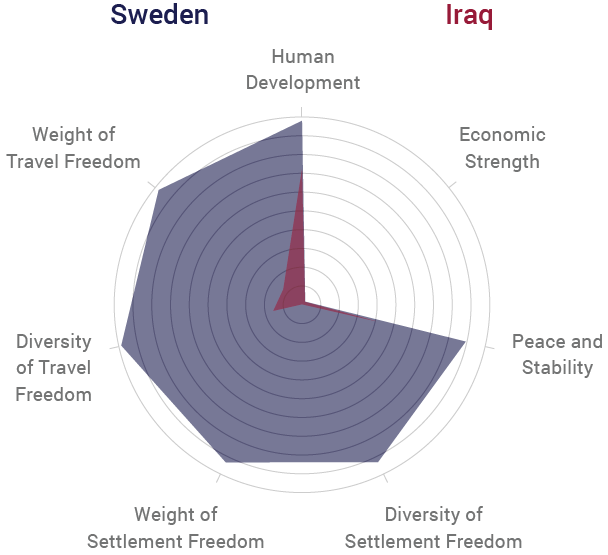
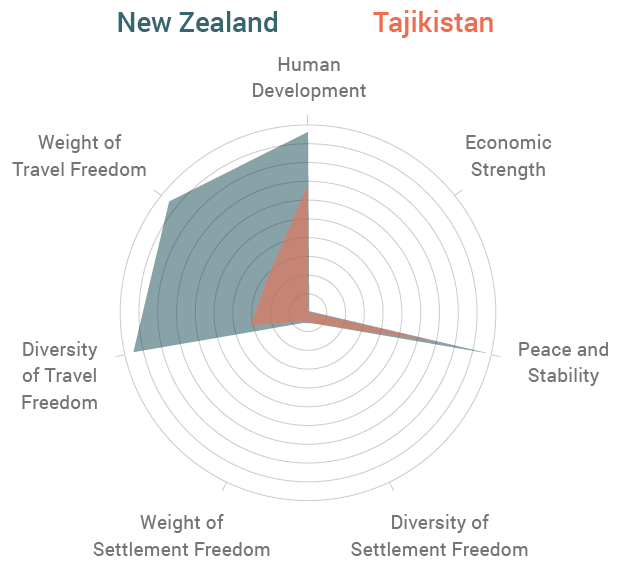
Updating this index annually will make sure that an up-to-date picture of the quality of world nationalities is readily available at any moment in time, illuminating medium- to long-term trends in nationalities’ development.
More Details of QNI Measurement and Ranking
The QNI ranks nationalities on a scale from 0% to 100%. Scores are rounded to one decimal place. These rankings consist of both internal and external factors. The weighting of internal and external factors within the QNI General Ranking is 40% and 60% respectively, both built from critical sub-elements, as outlined below.
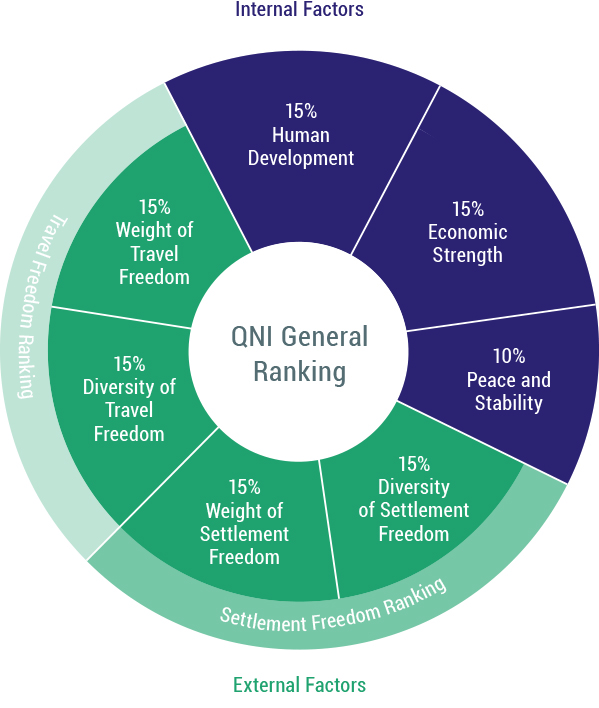
Internal Sub-Elements and Sources
Human Development is measured using the United Nations Development Programme Human Development Index which includes three dimensions of human development: health, education and standard of living.
Economic Strength is measured by a country’s share of world GDP at purchasing power parity (PPP), excluding rents from the exploitation of natural resources — so-called natural resources rents (NRR). Where no sufficiently recent and/or reliable PPP GDP data could be used, (non PPP) GDP data from the World Bank is applied. Both PPP GDP data and NRR data have been collected from the World Bank. For some countries, there is either no or only incomplete PPP GDP available in the World Bank database. Where no sufficiently recent or reliable PPP GDP data could be used, the most recent (non-PPP) GDPs from the United Nations Statistics Division, National Accounts Main Aggregate Database, Trading Economics, and the World Bank are applied. Since the countries for which PPP GDP data is unavailable generally have extremely small-scale economies, the use of nominal GDP figures is highly unlikely to have affected their ranking.
Peace and Stability is measured using figures from the annual Global Peace Index (GPI) published by the Institute for Economics and Peace. GPI scores are ranked on a scale from 1.000 (most peaceful) to 5.000 (least peaceful). These scores are converted to the normalized 0–10 scale for the QNI’s Peace and Stability parameter: the better a country scores on the GPI, the higher the Peace and Stability score of its corresponding nationality. The nationality of the most peaceful country receives the full 10% score, while a hypothetical score of 5.000 on the GPI would result in a 0% score for Peace and Stability.
External Sub-Elements and Sources
Diversity of Settlement Freedom measures the number of full-access countries that is, countries with their own border controls and immigration regimes where the holder of a particular nationality can freely work and live and is subject to either no or only minimal immigration requirements. Data on the Diversity of Settlement Freedom is gathered through extensive research of the literature on the legal requirements for settlement throughout the world. Research on the formal legal requirements is complemented with expert consultation in all regions of the world. This ensures that only real and genuine settlement freedom is taken into account, and sham legal freedoms are not considered. As no antecedent on this topic exists, the QNI is the only source on global Settlement Freedom worldwide.
Weight of Settlement Freedom measures the combined value of the countries that a nationality allows one to settle in. This Weight of Settlement Freedom value is composed of the sum of all such countries’ weighted scores on Human Development and Economic Strength, which both account for 50% of this ‘destination value’ for each destination. The sum of all these destination values becomes the total Weight of Settlement Freedom for a given nationality. This sum is normalized on a 0–15 scale.
Diversity of Travel Freedom measures the number of tourist- and business-access countries the holder of a particular nationality can visit visa-free or with a visa-on-arrival for a short-term stay. Work or recourse to public funds is usually strictly prohibited. To measure Diversity of Travel Freedom, data has been provided by the International Air Transport Association (IATA), the trade association of the overwhelming majority of airlines. IATA maintains IATA Timatic, the world’s largest and most reliable database of travel information. QNI data is based on the status quo on 1 July 2018. For the QNI, the country scores received by IATA are directly transposed to the corresponding nationality. The more destinations a nationality allows you to visit for tourist or business purposes without requiring a prior visa application, the higher that nationality’s value in terms of Diversity of Travel Freedom, again on a 0–15 scale.
Weight of Travel Freedom is based on the combined value of all countries allowing visa-free or visa-on-arrival tourist and business access to the holders of a nationality is composed of the sum of all of these countries’ weighted scores on Human Development (accounting for 50%) and Economic Strength (accounting for 50%).
Time of Measurement
This QNI edition represents the status quo on 1 July 2018. Where up-to-date data as of 1 July is not available, the most recently available data is used.
Quality Tiers for Nationalities
The QNI divides the nationalities of the world into five tiers:
- Very High Quality: Nationalities with a value of 75.0% and higher
- High Quality: Nationalities with a value of between 50.0% and 74.9%
- Medium Quality: Nationalities with a value of between 35.0% and 49.9%
- Low Quality: Nationalities with a value of between 20.0% and 34.9%
- Very Low Quality: Nationalities with a value of 19.9% and lower
QNI Explainer
Download a simple yet sophisticated explanation of the QNI here: QNI Explainer
The article by Prof. Dr. Dimitry Kochenov and Mr. Justin Lindeboom entitled ‘Empirical Assessment of the Quality of Nationalities’ was published in the European Journal of Comparative Law and Governance Volume 4:
Issue 4: brill.com/view/journals/ejcl/4/4/article-p314_314.xml